Ray Dalio Warns CBDCs Threaten Financial Privacy
Ray Dalio warns that CBDCs could erase financial privacy and give governments power to tax, seize funds, and control citizens.

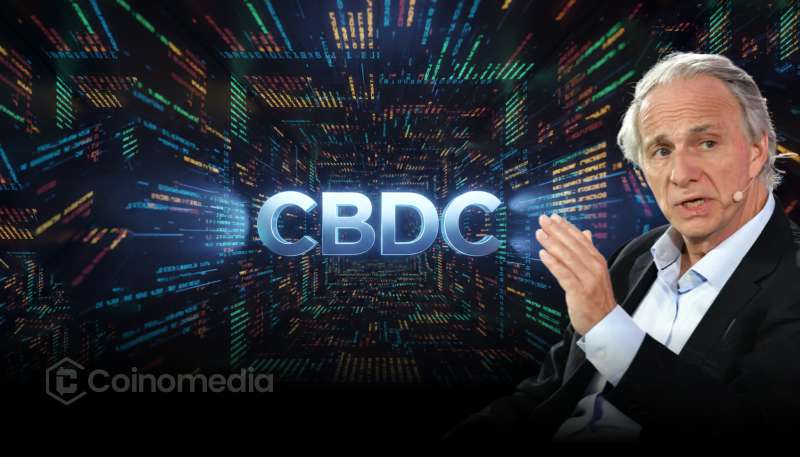
- Ray Dalio says CBDCs could end personal financial privacy.
- Governments may gain power to tax, freeze, or seize funds instantly.
- CBDCs could be used as a political control tool.
Billionaire investor Ray Dalio has issued a strong warning about the future of money. According to Dalio, central bank digital currencies (CBDCs) are not just a technical upgrade to cash. He believes they could fundamentally change the balance of power between individuals and governments. At the center of his concern is CBDC financial privacy, which he says may disappear once digital currencies are fully controlled by central banks.
Dalio argues that unlike cash, CBDCs allow every transaction to be tracked. This means governments could see how people earn, spend, and save money in real time. While officials often promote CBDCs as tools for efficiency and security, Dalio warns that this level of visibility could come at a high cost for personal freedom.
How CBDC Financial Privacy Could Be Lost
One of the biggest risks Dalio highlights is the ability for governments to directly tax or seize funds. With CBDCs, money could be programmed. Taxes might be deducted automatically, or accounts could be frozen without lengthy legal processes. In extreme cases, access to money could be cut off entirely.
This raises serious questions about CBDC financial privacy and personal control. If every transaction is monitored, citizens may lose the ability to make private financial decisions. Dalio believes this system could discourage dissent and limit economic freedom, especially in countries with weaker democratic institutions.
Political Power and CBDC Financial Privacy Risks
Dalio also warns that CBDCs could be used as a political weapon. Governments could block access to funds for individuals or groups seen as opponents. This possibility makes CBDC financial privacy not just a financial issue, but a human rights concern.
Supporters argue that safeguards can be built into the system. However, Dalio remains skeptical, pointing out that once the infrastructure exists, future leaders may use it in ways not originally intended. His warning adds to a growing debate about whether the convenience of CBDCs is worth the potential loss of freedom.
Read Also :
- APEMARS Stage 14 Takes the Crown as the Best Crypto to Buy Today as Bitcoin Dips Below $70K and Avalanche Trading Surges – Don’t Miss 3,000% ROI
- BTCC Exchange Named Official Regional Partner of the Argentine National Team
- Phemex Publishes April 2026 Proof of Reserves, Reporting 131% Total Reserve Ratio
- Bitcoin Mining Power Dominated by US China Russia
- Cango Inc. Completes $65M Investment and Secures $10M Convertible Note Financing