Polygon Price Prediction for 2026: As DeepSnitch AI Approaches Launch With 100x Potential, Can MATIC Bounce With a Bull Market?
Grayscale forecasts a 2026 bull run. Here’s the latest Polygon price prediction and the details of why DeepSnitch AI offers far stronger moonshot potential.


For Grayscale, pressure is building. Its research head cited macro strain and clearer regulation as catalysts for whatever comes next. And Metaplanet added $450M in Bitcoin through December, while Rep. Waters called for SEC oversight hearings over shifting enforcement priorities.
If you’re weighing Polygon price prediction scenarios against bigger opportunities, the landscape seems fairly complicated right now, as POL faces technical headwinds, but Layer 2 usage keeps growing.
But for those chasing asymmetric gains rather than recovery trades, DeepSnitch AI has something completely new on offer. Priced accessibly at $0.03142 and still in presale, the token has now climbed above 108% from its original price of $0.01510, with $1M raised.
Its full launch is just around the corner, and though the Polygon MATIC price forecast may improve, this presale not only offers more ceiling but also sharper utility to fuel a 100x run.

What lies ahead for crypto come 2026?
Grayscale’s argument is straightforward and hard to ignore. Government debt keeps expanding, fiscal deficits persist, and concerns about fiat currency debasement continue pushing investors toward alternatives. These macro imbalances are not going away anytime soon, which means the portfolio rotation into crypto should continue well into 2026. Add in bipartisan momentum behind US crypto legislation, and the operating environment looks more constructive than it has in years.
Corporate treasuries are not waiting around either. Metaplanet just added another 4,279 BTC to its holdings in late December, bringing its total stack above 35,000 Bitcoin worth roughly $3 billion. The Tokyo listed firm also reported that its Bitcoin income business generated above $50 million in 2025, proving that institutions can build real revenue streams around crypto holdings rather than just sitting on them.
On the political side, things remain lively. Representative Maxine Waters demanded an SEC oversight hearing after the agency dismissed major enforcement actions against Coinbase, Binance, and others. Whether you see this as healthy accountability or political theater, the friction itself is producing clearer rules. And clearer rules tend to bring in bigger money.
Three different setups as the market reprices risk
- DeepSnitch AI
DeepSnitch AI is the difference between observing the market and operating inside it. The platform has been shipping tools already, with launch coming up, and it’s already putting the kind of intelligence advantage usually reserved for large wallets into a system that everyday traders can actually use. This is not a later promise, as those who have already bought into the presale are already wielding the powerful utility of this rare platform.
Internally, the dashboard is already up and running, which makes a big difference in a market like this. SnitchFeed keeps an eye on large wallet activity as it unfolds, so you’re not finding out after the fact, while Token Explorer makes it easy to sanity-check any asset, laying out risk and holder concentration in a way that’s quick to read and hard to misinterpret. And with SnitchGPT, you can just ask what you want to know in plain English and get answers pulled from multiple data sources. DeepSnitch AI is less about staring at charts all day, and more about actually understanding what’s moving and why.
Launch is approaching quickly, and that timing is doing a lot of the heavy lifting here. DeepSnitch AI is still firmly in that early phase, where access is open and pricing hasn’t caught up to utility yet. That said, once launch hits, that imbalance tends to disappear fast.
Early holders benefit most because rewards begin compounding before broader demand arrives. And famously, outsized runs are built not by chasing momentum later but by positioning while the system is quietly working in the background.
For anyone aiming at a serious multiple rather than incremental gains, this pre-launch stretch is the best time to buy into DeepSnitch AI, especially as it gears up for launch and a 100x run in 2026.
- Polygon
Honest assessment is what’s shaping Polygon price predictions for December, across the board. POL dropped above 22% monthly, cracking below the crucial $0.118 support. And at $0.1043 as of December 30, with a $205M market cap, its price sits nearly 50% under the 200-day average.
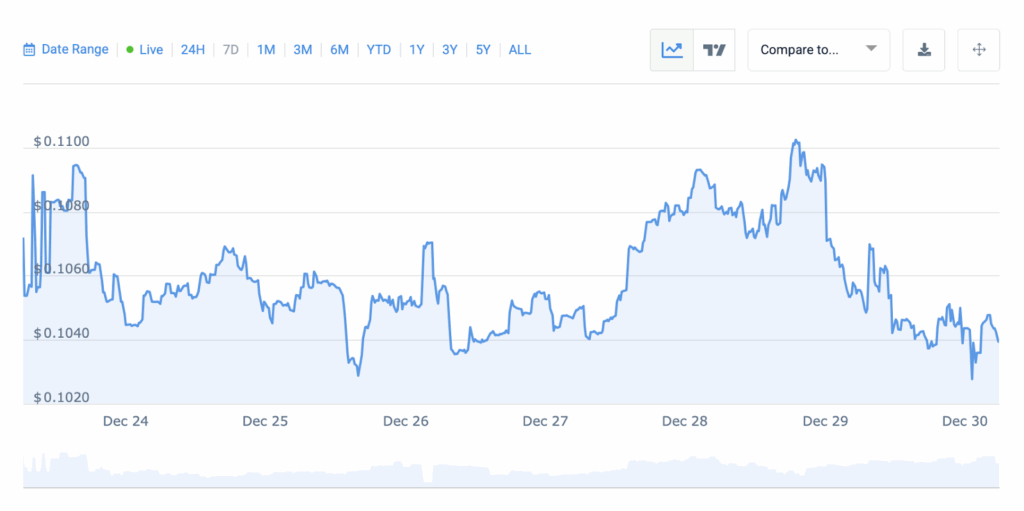
December’s RPC node incident compounded concerns, triggering 4% intraday losses and spotlighting validator concentration. Still, Polygon network growth is steady beneath the surface with active addresses expanding 30% month-over-month past 14 million and monthly transactions reaching above 170 million.
For the MATIC outlook to brighten, price needs to reclaim $0.127 and hold. The AggLayer v0.3 upgrade arrives in January, which could provide that catalyst. In the meantime, Polygon price predictions speak to fundamental support, although for 10x-100x rather than 50% bounces, you’d be wise to look toward presale entries instead, as these tokens stand to offer far more headroom.
- Arbitrum
Arbitrum paints a healthier picture, having above 1.7% in 24 hours, beating broader markets. At $0.1926 today with a $1.1B market cap, the network processed above 80% more transactions in December with nearly half the fees versus November.
Technically, ARB trades in a falling wedge since May with RSI near 46 showing oversold conditions easing. MACD turned positive for the first time since December 22nd, and real-world asset tokenization on Arbitrum crossed $50 million in Q4.
Analysts often single out Arbitrum as a rare bright spot in an otherwise heavy altcoin landscape. The ecosystem has expanded roughly 200% even as the token price lagged, and with around $20 billion in TVL, the fundamentals look far healthier than the chart suggests.
That said, ARB’s relative strength comes with a caveat: roughly 35% annual supply inflation continues to weigh on price by steadily adding dilution. For cleaner asymmetric bets on the Polygon price prediction timeframe, presale tokens still offer tidier entries.
Final word
Macro conditions are lining up in crypto’s favor heading into 2026. While established Layer 2s wrestle with upgrades, outages, and the same technical hurdles baked into every Polygon price prediction, DeepSnitch AI is already shipping working AI tools at presale valuations.
There’s still time to enter early. And until January 1, you can use DSNTVIP50 for a 50% bonus on purchases above $2,000, or DSNTVIP100 for a 100% bonus on $5,000 and up. Just connect your wallet, click “Do you have a promo code?” in the widget, and apply it on the official website.
There, you’ll get access to the presale, but you can also find out more with ongoing development updates shared on X and Telegram.

FAQs
What’s the Polygon price prediction for 2026?
Most Polygon price predictions reflect general agreement that a real recovery will only commence if the price can reclaim $0.127. Until then, upside looks constrained. By contrast, DeepSnitch AI sits at presale pricing with far more room to move, offering a risk-reward profile that simply isn’t available once a token reaches Polygon’s scale.
Does Arbitrum beat Polygon as a Layer 2 investment?
Both do a solid job of extending Ethereum’s capacity. But when it comes to asymmetric upside beyond any MATIC outlook, DeepSnitch AI’s presale pricing offers a kind of multiplication that billion-dollar tokens are structurally unable to deliver.
Can smaller tokens outperform established Layer 2s?
Once a token reaches a large market cap, percentage upside shrinks no matter how well the network performs. DeepSnitch AI sits on the opposite end of that curve, where early pricing still leaves room for multiples that established tokens simply can’t produce.