Ethereum Price Analysis 2026: Can ETH Recover From $2,000?
Ethereum price analysis for 2026: ETH struggles near $2,000 as investors explore alternatives. Comparing established blockchain vs Mutuum Finance DeFi protocol.


Ethereum remains one of the most important blockchains in the crypto market, but recent price action has raised new questions about its long term direction. After dropping toward the $2,000 level, ETH has struggled to regain strong momentum, leaving investors unsure about what 2026 may hold. Market conditions, competition, and shifting capital flows are all playing a role in Ethereum’s current position.
This Ethereum price analysis for 2026 explores whether ETH can recover from the $2,000 zone or face a longer consolidation phase. By examining key price levels, network fundamentals, and broader crypto market trends, investors can better understand what may influence Ethereum’s next major move.
Ethereum (ETH)
As of February 2026, Ethereum is trading in a fragile range near $2,060, reflecting a sharp correction from its 2025 all-time high of nearly $4,950. While its market capitalization remains massive at approximately $250 billion, this high valuation has become a double-edged sword.
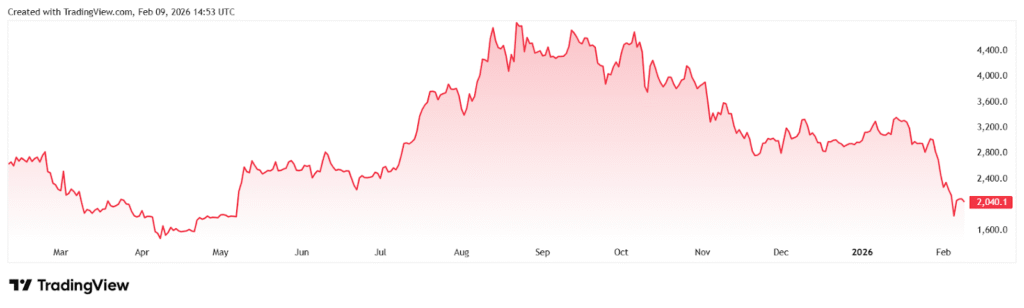
For institutional players, Ethereum represents stability; however, for retail investors, the sheer size of ETH’s market cap limits the potential for “life-changing” gains in the short term. To see a simple 2x return, Ethereum requires an additional $250 billion in liquidity—a tall order in a market currently dominated by risk-off sentiment.
Technically, Ethereum is facing formidable resistance zones. For a sustainable recovery to begin, ETH must first reclaim the $2,800 to $3,000 zone, which has flipped from strong support to a heavy ceiling.
If ETH fails to break through this area, bearish analysts predict further downside pressure toward the mid-2025 lows of $1,400. This stagnation has led a growing number of investors to rotate their capital into lower-cost tokens with higher upside potential, specifically those building the next generation of credit infrastructure.
Mutuum Finance (MUTM)
Mutuum Finance (MUTM) is positioning itself as a destination for DeFi crypto capital by focusing on a non custodial, on chain lending system built for flexibility and transparency. The protocol is designed around a dual market structure intended to address limits seen in older lending platforms. These two models are Peer to Contract P2C and Peer to Peer P2P, with each serving a different use case.
The P2C model, which forms the foundation of the current protocol design, is built for instant liquidity. Users supply funds such as ETH or USDT into shared liquidity pools and receive mtTokens like mtETH in return. These mtTokens act as interest bearing receipts. Instead of remaining static, their redeemable value increases over time as borrowers repay with interest. Yield is variable and adjusts based on pool usage, meaning higher borrowing demand can lead to higher APY for suppliers.
The P2P market is a planned feature that remains under development. Once implemented, it is intended to allow lenders and borrowers to set custom terms directly with each other. This model is designed for tokens or scenarios that may not fit standard pool parameters, offering more flexibility while keeping risk isolated from pooled liquidity.
Borrowing across the system is over collateralized and managed by clear risk rules. For example, a borrower may access liquidity at an LTV of around 70%, depending on the pool. Positions are monitored by an automated, code driven liquidation process.

MUTM Growth & Security
The growth of Mutuum Finance is backed by a highly successful and transparent funding roadmap. The project has raised over $20.4 million to date, attracting more than 19,000 individual holders.
Currently, Mutuum is in its Phase 7 presale, with the MUTM token priced at $0.04. With a confirmed launch price of $0.06, investors entering at this stage are positioned for an immediate 50% advantage before public trading even begins.
Security is not an afterthought for the MUTM team; it is the project’s backbone. Mutuum has completed a comprehensive security audit with Halborn, an elite firm known for identifying systemic risks in major DeFi platforms. This is bolstered by a 90/100 Token Scan score from CertiK and an active $50,000 bug bounty program.
This level of professional scrutiny provides the safety net that institutional-grade capital requires. Furthermore, the platform features a 24-hour leaderboard that publicly tracks contributions and rewards the top daily participant with $500 in MUTM, fostering a high level of community engagement and transparency.
Protocol Launch and the Path to 2027
The technical roadmap for Mutuum Finance is moving at a rapid pace. The V1 protocol has officially activated on the Sepolia testnet, allowing users to interact with liquidity pools, mtTokens, and debt-tracking mechanisms in a risk-free environment. This milestone proves that the project is no longer just a concept but a functional piece of financial software.
Looking ahead, according to the official roadmap, Mutuum Finance plans to launch its own native, over-collateralized stablecoin. This asset will allow users to mint a stable medium of exchange directly against their interest-bearing collateral, further increasing the utility of the MUTM token.
As Phase 7 quickly sells out, the window to enter at $0.04 is closing. While Ethereum struggles to reclaim its $3,000 resistance, analysts suggest that MUTM’s combination of revenue-linked utility and high-security standards could lead to a 500% to 700% upside by the end of 2026. When looking for the skyrocket opportunities of the next crypto market cycle, the focus is shifting away from the old giants and toward the fresh, audited innovation of Mutuum Finance.
For more information about Mutuum Finance (MUTM) visit the links below:
Website: https://www.mutuum.com
Linktree: https://linktr.ee/mutuumfinance